"Nobody cares what you think" is something they drill into you in law school, but sometimes I find myself wishing that it was taught to everyone, aspiring lawyer or not. Of course, much of the time it's used to correct the speech habits of students preparing for their first year moot, when prefacing any statement with "I think..." is just a bad idea anyway. But the true significance of this idea is subtle, and may take several years to sink in.
It doesn't mean that no one wants to hear what you have to say. It means that whether or not you believe what you are saying, and how strongly you believe it, is of no relevance. What your audience cares about is whether or not there are good reasons for them to believe it. In the practice of law, especially, your actual opinion doesn't matter, because you might well believe your client is probably guilty, but your job is not to decide that, but to advise the court as to the best arguments available for why there's a reasonable doubt.
I've had the opportunity to judge some junior high school debates, and find students very often falling into a similar trap. A speaker would stand up and deliver an impassioned speech starting out with "We strongly believe that the proposition must stand!" This is silly, because we know very well that in the next round, the very same speaker will be emphatically stating how strongly they believe the very same proposition must fall. And so the point here is the same as the one in law school: nobody cares what the speaker believes; we want to hear the arguments for why we should believe, preferable arguments we haven't considered before.
I was recently reminded of this lesson on a message forum I frequent. We had been discussing some topic or other, the death penalty, I believe, and had gone on for some five or six pages of posts arguing about whether or not capital punishment is cheaper than life imprisonment (it's not, when you take into account the appeals process necessary to make sure we don't execute someone innocent). And then, of course, after all this lengthy and thorough discussion, someone joins in posting his opinion that we shouldn't waste money on keeping these monsters alive in prison, and should just shoot them.
Obviously the poster hadn't read any of the thread, and was unaware or just didn't care that his arguments had already been presented and dissected in fine detail. No, he just wanted to tell us what he thought, sparking a new round of debunking the same old arguments. But why would anyone care to know that he, this anonymous person on the internet out there, happens to hold a particular and demonstrably common opinion? We aren't voting on it. We don't know him, we don't have any reason to be affected in any way by the fact that he holds or does not old that view. What we want to know is if there are good reasons why we should share that view. And if he'd taken the time to peruse the thread rather than boldly announcing his not-at-all unusual perspective, he'd know that the arguments he brought to bear were old news to the participants.
Now, it's not necessarily true that no one cares what you think. Some people probably do, and of course when we're voting on something, what each person thinks is aggregated together to give a result. And when you're planning a dinner party, it's good to know what each guest's culinary preferences are. But most of the time, it's a good guiding principle to bear in mind that the mere fact of your preferring A over B is of no value to anyone but you.
Monday, 20 August 2012

Sunday, 12 August 2012
Guns Don't, People Do.
There are all sorts of arguments for and against legal restrictions on gun ownership, but one of the more disturbing arguments I hear from time to time is the one that certain Americans raise: that an armed populace is the best defence against a tyrannical government.
Now, I don't mean to reject that entirely, because certainly there have been many tyrannical governments overthrown by force of arms throughout history. And there are instances where armed citizenry have made it difficult or even impossible for foreign powers to invade and occupy a country. A realist must recognize that there is a role for weapons and violence in this world, if only because others give them a role. I certainly understand the sentiment (misattributed to Thomas Jefferson) that it is better for government to fear the people than for people to fear the government, though I disagree very much: it is fearful governments that are the most dangerous to their people. (More on that in a later post, I expect; I've been meditating again on the nature of fear quite a bit since this Officer Wawra story broke.)
But this whole approach to combatting government tyranny is doomed, because it buys into Mao's famous dictum that political power grows out of the barrel of a gun, and that view of power is at the core of tyranny. One can imagine (or at least fantasize about) a benevolent tyranny where those with a monopoly on lethal force wield it with benign restraint and only for our own good, but tyranny is tyranny is tyranny.
No, the answer to tyranny is not force. The truly revolutionary development that has lead to the spread of liberty was not the idea of arming the populace. There was nothing at all new about that; weapons have existed in private hands far longer than we've even had governments. The really important change has been the growth of the rule of law, the idea that people have rights and that disputes should be settled according to generally accepted universal principles rather than the personal preferences of any individual.
This is much more than simply an idea that people hear about; there's probably no society without at least the idea of rules. What matters for the rule of law to take root is for enough people to genuinely embrace the concept, and to agree to abide by rules even when it is not in their immediate interest to do so. And of particular importance is that the people with the guns firmly adhere to this principle. That's why the militaries of developed countries are ultimately under lawful civilian control, and have such strict disciplinary systems in place.
It's a subtle idea, and while it's well-established here, its grip is always a bit tenuous. Sometimes it's counterintuitive, as when we extend legal protections and due process to the nastiest of criminals. Sometimes it's just inconvenient, like when we stop for a red light at 3:00 a.m. and there's no one else on the road. But the fact that most of us usually obey the law for no other reason than that it is the law is the core of what protects us against tyranny. A tyrant can only become a tyrant if people obey him, and in a rule-of-law society, unlawful commands tend not to be obeyed.
So the thing to do is to be ever vigilant against attempts to shape the law to the purposes of the tyrant. That means engaging in the political process, arguing and advocating and talking and listening, and steadfastly rejecting coercion. In other words, guns don't protect us against tyranny; people protect us against tyranny.
Now, I don't mean to reject that entirely, because certainly there have been many tyrannical governments overthrown by force of arms throughout history. And there are instances where armed citizenry have made it difficult or even impossible for foreign powers to invade and occupy a country. A realist must recognize that there is a role for weapons and violence in this world, if only because others give them a role. I certainly understand the sentiment (misattributed to Thomas Jefferson) that it is better for government to fear the people than for people to fear the government, though I disagree very much: it is fearful governments that are the most dangerous to their people. (More on that in a later post, I expect; I've been meditating again on the nature of fear quite a bit since this Officer Wawra story broke.)
But this whole approach to combatting government tyranny is doomed, because it buys into Mao's famous dictum that political power grows out of the barrel of a gun, and that view of power is at the core of tyranny. One can imagine (or at least fantasize about) a benevolent tyranny where those with a monopoly on lethal force wield it with benign restraint and only for our own good, but tyranny is tyranny is tyranny.
No, the answer to tyranny is not force. The truly revolutionary development that has lead to the spread of liberty was not the idea of arming the populace. There was nothing at all new about that; weapons have existed in private hands far longer than we've even had governments. The really important change has been the growth of the rule of law, the idea that people have rights and that disputes should be settled according to generally accepted universal principles rather than the personal preferences of any individual.
This is much more than simply an idea that people hear about; there's probably no society without at least the idea of rules. What matters for the rule of law to take root is for enough people to genuinely embrace the concept, and to agree to abide by rules even when it is not in their immediate interest to do so. And of particular importance is that the people with the guns firmly adhere to this principle. That's why the militaries of developed countries are ultimately under lawful civilian control, and have such strict disciplinary systems in place.
It's a subtle idea, and while it's well-established here, its grip is always a bit tenuous. Sometimes it's counterintuitive, as when we extend legal protections and due process to the nastiest of criminals. Sometimes it's just inconvenient, like when we stop for a red light at 3:00 a.m. and there's no one else on the road. But the fact that most of us usually obey the law for no other reason than that it is the law is the core of what protects us against tyranny. A tyrant can only become a tyrant if people obey him, and in a rule-of-law society, unlawful commands tend not to be obeyed.
So the thing to do is to be ever vigilant against attempts to shape the law to the purposes of the tyrant. That means engaging in the political process, arguing and advocating and talking and listening, and steadfastly rejecting coercion. In other words, guns don't protect us against tyranny; people protect us against tyranny.
Sunday, 5 August 2012
The Good News about Bad News
Marshall McLuhan famously remarked that while we don't know who discovered water, it probably wasn't the fish. I want to say something about the good news that we don't notice in the background of horrible events such as the shooting in Aurora last week, because we are so deeply immersed in the good news that we don't even recognize it as significant.
The good news is that these shootings are news at all. We are shocked and horrified and saddened by these events, and rightly so, for they are shocking and horrifying and sad, but we are also shocked because they are, for the most part, unusual. True, they happen much more often than we'd like; every few months some pathetic loser thinks he can bring meaning to his life through some spectacular orgy of violence. But that's not really so often, when you think about it on a global scale. It's rare enough that it makes the news if it happens anywhere in the developed world.
Think what things were like a thousand years ago. Whole villages were massacred in Viking raids, but the news spread slowly, and even if there had been a global satellite network to share information instantly around the world, it wouldn't have been broadcast anyway, because no one cared. It wasn't news, anymore than a fatal car accident in Toronto attracts the attention of strangers in Buenos Aires; they have their own fatal car accidents to be worried about. "A village 20 miles away was slaughtered in a raid? Oh, yeah, that happened to my cousin six years ago." And compared to the level of violence that was commonplace in those days, for 12 people to die in one incident would have been quite unremarkable, except perhaps to those who actually knew any of the victims.
Even a hundred years ago, violence was far more common than it is today. Less than that, even; I happened to catch a snippet of an old Flintstones episode where Fred was trying to bully Barney into going along with some scheme or other, menacing him with a fist. I was actually a little shocked; our cultural sensitivities towards casual violence have changed so much.
We no longer accept violence as an appropriate way to resolve our differences. Well, that's not completely true; we still glorify it in TV and movies, and people talk about how they'd love to punch or shoot some person or other, but for the most part, we reject it as a dispute resolution mechanism. If you have a problem with someone today, you are expected to talk it out, resolve it peacefully, and if that fails, sue. In the past, however, violence was viewed as a perfectly natural and even appropriate way of getting what you wanted. Not getting enough from farming, fishing and hunting? Well, raid a neighbouring village or tribe.
To be sure, there are still lots of people who resort to violence. But the spectacular shootings that make the news every so often have a different kind of motive. These are not people robbing banks or trains, trying to take economic resources by force. These are typically dissatisfied and unfulfilled losers looking for fame and notoriety. They want to be able to think of themselves as important and powerful, and I suppose they want our help and that of the press to reinforce that. But the point here is that shocking acts of violence get them that attention, and why? Because violence is no longer commonplace; it is rare enough today that it actually does shock us.
That is the good news. This kind of violence happens in part because other kinds of violence don't happen so much anymore. In a way, it's a symptom of success. Human society may always have some level of violence, and if we're getting to the point where some of that violence is due to the very fact that we find violence unusual, I think that in the big picture, that's something to be thankful for.
But it can be better. I think that if we were to recognize violence not as something evil, scary and mysterious, but perfectly mundane and distasteful, we could remove some of the reason for this kind of shooting. Decent people will handle feces if they must (changing diapers, cleaning up after a pet, maintenance of plumbing, etc.) but there's nothing mysterious or heroic about it, and we all try to avoid it as much as possible. Someone who runs into a movie theatre and flings poo at the audience is not viewed with awe as a supervillain, but with contempt. If we could somehow replace our fear of violence with contempt, then maybe these attention-cravers will find a more constructive way to get their fifteen minutes.
The good news is that these shootings are news at all. We are shocked and horrified and saddened by these events, and rightly so, for they are shocking and horrifying and sad, but we are also shocked because they are, for the most part, unusual. True, they happen much more often than we'd like; every few months some pathetic loser thinks he can bring meaning to his life through some spectacular orgy of violence. But that's not really so often, when you think about it on a global scale. It's rare enough that it makes the news if it happens anywhere in the developed world.
Think what things were like a thousand years ago. Whole villages were massacred in Viking raids, but the news spread slowly, and even if there had been a global satellite network to share information instantly around the world, it wouldn't have been broadcast anyway, because no one cared. It wasn't news, anymore than a fatal car accident in Toronto attracts the attention of strangers in Buenos Aires; they have their own fatal car accidents to be worried about. "A village 20 miles away was slaughtered in a raid? Oh, yeah, that happened to my cousin six years ago." And compared to the level of violence that was commonplace in those days, for 12 people to die in one incident would have been quite unremarkable, except perhaps to those who actually knew any of the victims.
Even a hundred years ago, violence was far more common than it is today. Less than that, even; I happened to catch a snippet of an old Flintstones episode where Fred was trying to bully Barney into going along with some scheme or other, menacing him with a fist. I was actually a little shocked; our cultural sensitivities towards casual violence have changed so much.
We no longer accept violence as an appropriate way to resolve our differences. Well, that's not completely true; we still glorify it in TV and movies, and people talk about how they'd love to punch or shoot some person or other, but for the most part, we reject it as a dispute resolution mechanism. If you have a problem with someone today, you are expected to talk it out, resolve it peacefully, and if that fails, sue. In the past, however, violence was viewed as a perfectly natural and even appropriate way of getting what you wanted. Not getting enough from farming, fishing and hunting? Well, raid a neighbouring village or tribe.
To be sure, there are still lots of people who resort to violence. But the spectacular shootings that make the news every so often have a different kind of motive. These are not people robbing banks or trains, trying to take economic resources by force. These are typically dissatisfied and unfulfilled losers looking for fame and notoriety. They want to be able to think of themselves as important and powerful, and I suppose they want our help and that of the press to reinforce that. But the point here is that shocking acts of violence get them that attention, and why? Because violence is no longer commonplace; it is rare enough today that it actually does shock us.
That is the good news. This kind of violence happens in part because other kinds of violence don't happen so much anymore. In a way, it's a symptom of success. Human society may always have some level of violence, and if we're getting to the point where some of that violence is due to the very fact that we find violence unusual, I think that in the big picture, that's something to be thankful for.
But it can be better. I think that if we were to recognize violence not as something evil, scary and mysterious, but perfectly mundane and distasteful, we could remove some of the reason for this kind of shooting. Decent people will handle feces if they must (changing diapers, cleaning up after a pet, maintenance of plumbing, etc.) but there's nothing mysterious or heroic about it, and we all try to avoid it as much as possible. Someone who runs into a movie theatre and flings poo at the audience is not viewed with awe as a supervillain, but with contempt. If we could somehow replace our fear of violence with contempt, then maybe these attention-cravers will find a more constructive way to get their fifteen minutes.
Saturday, 28 July 2012
Little Joys of Discovery #1A
This post is just a followup of the one in which I mentioned leafcutter bees, as now I've had the chance to capture a couple of photographs of some.
On occasion you might notice the signs of leafcutter bee activity before you see the bees themselves. This is a picture of some leaves on flowers in our garden, where you can see a few neatly cut-out sections. I'd seen this sort of thing many times before I learned of leafctter bees, and assumed some caterpillar was at work, but I was puzzled as to why it seemed to have eaten in such regular patterns and left, rather than just devouring the whole leaf.

I didn't get a picture of any bees actually harvesting these leaves, so maybe these were done by fickle caterpillars after all, but my money's on the bees.
When I first went outside with camera in hand, hoping to stake out a nesting site where I'd seen a bee the day before, I first crouched down to look around the porch steps to see if I could find the entrance to the nest. Then, I happened to notice that sitting right there on the step was a resting bee, complete with a piece of leaf, almost as if waiting for me to come take her picture.

And as soon as I took this shot, she flew away.
Unlike honeybees, leafcutters are not eusocial; all the females lay their own eggs, rather than tending to the eggs of their mother the queen. According to this site, all leafcutter species are solitary, but alfalfa leafcutter bees (Megachile rotunda) are happy to build nests in close proximity to each other, which is why I think the ones in my backyard are of that species. Each of the drainage holes in the base of these flowerpots is the front door to a leafcutter's burrow; I saw bees come and go from all of them, but they're pretty quick, and it was hard to catch good still photos of any of them. I did manage to catch a little video of some, which I've put on my YouTube channel. Boy, nature photography takes patience!

On occasion you might notice the signs of leafcutter bee activity before you see the bees themselves. This is a picture of some leaves on flowers in our garden, where you can see a few neatly cut-out sections. I'd seen this sort of thing many times before I learned of leafctter bees, and assumed some caterpillar was at work, but I was puzzled as to why it seemed to have eaten in such regular patterns and left, rather than just devouring the whole leaf.

I didn't get a picture of any bees actually harvesting these leaves, so maybe these were done by fickle caterpillars after all, but my money's on the bees.
When I first went outside with camera in hand, hoping to stake out a nesting site where I'd seen a bee the day before, I first crouched down to look around the porch steps to see if I could find the entrance to the nest. Then, I happened to notice that sitting right there on the step was a resting bee, complete with a piece of leaf, almost as if waiting for me to come take her picture.

And as soon as I took this shot, she flew away.
Unlike honeybees, leafcutters are not eusocial; all the females lay their own eggs, rather than tending to the eggs of their mother the queen. According to this site, all leafcutter species are solitary, but alfalfa leafcutter bees (Megachile rotunda) are happy to build nests in close proximity to each other, which is why I think the ones in my backyard are of that species. Each of the drainage holes in the base of these flowerpots is the front door to a leafcutter's burrow; I saw bees come and go from all of them, but they're pretty quick, and it was hard to catch good still photos of any of them. I did manage to catch a little video of some, which I've put on my YouTube channel. Boy, nature photography takes patience!

Wednesday, 25 July 2012
Why do Persons Have Rights? A reader asks...
A reader emailed me with the following question: Why does a person have rights?
First of all, it's not clear they do, in the absolute cosmic sense. But if rights exist at all, then persons are the things that will have them, by definition.
Persons I define as moral agents, beings who are capable of having interests, acting upon them, and who may be said to have moral obligations in some sort. Rights are a form of moral obligation; if you have a right to life, I have a moral obligation not to kill you. If I have a moral obligation to treat you with respect, you may be said to have a right to be treated with respect. And so on.
(I'm distinguishing moral obligation from prudential reasons to do something, here. It might be in MY best interests to treat you with respect or not to kill you, but the fact that I'm better off by doing something is not what creates moral obligation.)
Now, this doesn't answer the question as to why persons have rights, or why non-persons don't have rights. I may have a moral obligation not to burn the Mona Lisa; doesn't that translate into the Mona Lisa having a right not to be burned? Well, no; I'd rather say that everyone else has a right to keep the Mona Lisa in existence, and it's that right I'd be violating, not any right the painting itself has.
So why do persons have rights? I think it goes hand in hand with the notion of personhood and moral agency, or the exercise of autonomy. We make choices base on what we feel to be right, whatever that means, and while we may not know what right is in all cases, we still have to choose. And it's autonomous agents, PERSONS who much choose. So in a practical sense, it's persons who determine what matters and what doesn't.
Your choice between chocolate or vanilla is an exercise of your will and your determination that one or the other flavour will better satisfy your interests. I presume that the satisfaction of interests is ultimately what we're interested in as choosing beings, and since persons are the seat of interests, I believe it follows that we have an obligation to defer to others with respect to their own determination of their interests. Hence it's not for me to decide whether you should have chocolate or vanilla, when it's you who are better situated to identify your interests.
It gets complicated with interests clash, and that's where rights come in. I may actually have an interest in your eating chocolate and abstaining from vanilla for some reason. (For something like this, it's probably an irrational reason, but who cares? I don't want to beg any questions about what constitutes a valid or an invalid interest. Maybe I think God hates vanilla or something, or maybe I'm deathly allergic to the presence of vanilla byproducts in the sweat of people I might shake hands with.) Rights are the way we try to balance conflicting interests, by identifying a systematic priority of interests. So there's core interests we all have in common, which we agree to treat as paramount. My right to believe God is pleased that you don't eat vanilla is, presumably, less central to the protection of my autonomy than my right to choose what flavour I eat myself, and so I must recognize that YOUR autonomous right to eat what you want trumps my pleasing-God interest. But if I'm deathly allergic to vanilla byproducts, my right to remain alive might well trump your choice of ice cream in contexts where it might make a difference.
First of all, it's not clear they do, in the absolute cosmic sense. But if rights exist at all, then persons are the things that will have them, by definition.
Persons I define as moral agents, beings who are capable of having interests, acting upon them, and who may be said to have moral obligations in some sort. Rights are a form of moral obligation; if you have a right to life, I have a moral obligation not to kill you. If I have a moral obligation to treat you with respect, you may be said to have a right to be treated with respect. And so on.
(I'm distinguishing moral obligation from prudential reasons to do something, here. It might be in MY best interests to treat you with respect or not to kill you, but the fact that I'm better off by doing something is not what creates moral obligation.)
Now, this doesn't answer the question as to why persons have rights, or why non-persons don't have rights. I may have a moral obligation not to burn the Mona Lisa; doesn't that translate into the Mona Lisa having a right not to be burned? Well, no; I'd rather say that everyone else has a right to keep the Mona Lisa in existence, and it's that right I'd be violating, not any right the painting itself has.
So why do persons have rights? I think it goes hand in hand with the notion of personhood and moral agency, or the exercise of autonomy. We make choices base on what we feel to be right, whatever that means, and while we may not know what right is in all cases, we still have to choose. And it's autonomous agents, PERSONS who much choose. So in a practical sense, it's persons who determine what matters and what doesn't.
Your choice between chocolate or vanilla is an exercise of your will and your determination that one or the other flavour will better satisfy your interests. I presume that the satisfaction of interests is ultimately what we're interested in as choosing beings, and since persons are the seat of interests, I believe it follows that we have an obligation to defer to others with respect to their own determination of their interests. Hence it's not for me to decide whether you should have chocolate or vanilla, when it's you who are better situated to identify your interests.
It gets complicated with interests clash, and that's where rights come in. I may actually have an interest in your eating chocolate and abstaining from vanilla for some reason. (For something like this, it's probably an irrational reason, but who cares? I don't want to beg any questions about what constitutes a valid or an invalid interest. Maybe I think God hates vanilla or something, or maybe I'm deathly allergic to the presence of vanilla byproducts in the sweat of people I might shake hands with.) Rights are the way we try to balance conflicting interests, by identifying a systematic priority of interests. So there's core interests we all have in common, which we agree to treat as paramount. My right to believe God is pleased that you don't eat vanilla is, presumably, less central to the protection of my autonomy than my right to choose what flavour I eat myself, and so I must recognize that YOUR autonomous right to eat what you want trumps my pleasing-God interest. But if I'm deathly allergic to vanilla byproducts, my right to remain alive might well trump your choice of ice cream in contexts where it might make a difference.
Tuesday, 24 July 2012
The Greatest Trick the Devil Ever Pulled
I just received an email from a friend of my parents with a political joke in it. Apologies for abridging it and spoiling the punchline, but the gist of it is this: A little girl calls her newborn kittens, whose eyes haven't opened yet, "Liberals", and later, when their eyes have opened, she calls them "Conservatives".
Ha ha. Cute.
Yet I found it troubling, because it is part of perpetuating the myth that conservatives are somehow the hard-headed realists who know how the world really works, and everyone else is a naive idealist. And that's simply false.
The source of the confusion, of course, is the word "conservative". By itself, it's a fine word, and it's conveys an admirable sense of caution and thrift. To be conservative is to avoid unnecessary risk and expense, and these are both things that we'd want in our leaders. It's natural to hope that this kind of conservatism (cautious and thrifty) is rooted in an understanding of how very wrong things can go if we're not careful, and it's natural to import this idea that conservatives' eyes are open to the harsh realities of the world.
But there's a danger in that assumption, and all the more so because it's so seductively reasonable. If you buy into the idea that you are wise to the ways of the world, while others are naive and gullible, you become especially naive and gullible yourself. You become smug and complacent, and feel that you don't need to listen to the ideas of those naive and gullible idealists who have no idea what the real world is like. Their eyes are closed, and yours are open, so you can't be fooled. Heck, you know how things really are, so you don't even need to look anymore...
And that, I fear, is exactly what's happened, as evidenced by the joke I referred to at the beginning of this post. Conservatives have become so confident in their superior expertise (and the utter worthlessness of any opinion that doesn't bear the label "conservative") that they are willing to barge on ahead with policies based entirely on idealistic visions of how the economy is supposed to work, or "common sense" ideas of how the criminal justice system is supposed to work, or how foreign governments ought to respond to our clearly superior morality.
(Our own federal Conservatives have been systematically closing their eyes by slashing funding to Statistics Canada and a host of other government agencies and research programs intended to give government and Canadians the objective information needed to make sound decisions. Republicans in the United States have been doing much the same with not just budget cuts but also legislation like the Data Quality Act.)
The scorn I sense from conservatives in expressing their opinions about things is palpable. They talk about how obvious it is that this or that policy is the right one, and how stupid anyone would have to be not to see it. Well, if everything true was obvious, and everything obvious were true, this would be a very different world. There are things which seem obvious but are in fact false, and truths which are very subtle and profoundly counterintuitive. You cannot hope to understand these things if you think you already do.
I love the quote from The Usual Suspects: "The greatest trick the devil ever pulled was convincing the world he didn't exist." There is no surer way to keep your eyes closed than to convince yourself they're wide open.
Ha ha. Cute.
Yet I found it troubling, because it is part of perpetuating the myth that conservatives are somehow the hard-headed realists who know how the world really works, and everyone else is a naive idealist. And that's simply false.
The source of the confusion, of course, is the word "conservative". By itself, it's a fine word, and it's conveys an admirable sense of caution and thrift. To be conservative is to avoid unnecessary risk and expense, and these are both things that we'd want in our leaders. It's natural to hope that this kind of conservatism (cautious and thrifty) is rooted in an understanding of how very wrong things can go if we're not careful, and it's natural to import this idea that conservatives' eyes are open to the harsh realities of the world.
But there's a danger in that assumption, and all the more so because it's so seductively reasonable. If you buy into the idea that you are wise to the ways of the world, while others are naive and gullible, you become especially naive and gullible yourself. You become smug and complacent, and feel that you don't need to listen to the ideas of those naive and gullible idealists who have no idea what the real world is like. Their eyes are closed, and yours are open, so you can't be fooled. Heck, you know how things really are, so you don't even need to look anymore...
And that, I fear, is exactly what's happened, as evidenced by the joke I referred to at the beginning of this post. Conservatives have become so confident in their superior expertise (and the utter worthlessness of any opinion that doesn't bear the label "conservative") that they are willing to barge on ahead with policies based entirely on idealistic visions of how the economy is supposed to work, or "common sense" ideas of how the criminal justice system is supposed to work, or how foreign governments ought to respond to our clearly superior morality.
(Our own federal Conservatives have been systematically closing their eyes by slashing funding to Statistics Canada and a host of other government agencies and research programs intended to give government and Canadians the objective information needed to make sound decisions. Republicans in the United States have been doing much the same with not just budget cuts but also legislation like the Data Quality Act.)
The scorn I sense from conservatives in expressing their opinions about things is palpable. They talk about how obvious it is that this or that policy is the right one, and how stupid anyone would have to be not to see it. Well, if everything true was obvious, and everything obvious were true, this would be a very different world. There are things which seem obvious but are in fact false, and truths which are very subtle and profoundly counterintuitive. You cannot hope to understand these things if you think you already do.
I love the quote from The Usual Suspects: "The greatest trick the devil ever pulled was convincing the world he didn't exist." There is no surer way to keep your eyes closed than to convince yourself they're wide open.
Saturday, 21 July 2012
Was the Apollo Mission a Waste of Money?
You are probably familiar with this photograph.

This very famous image of Earth was taken by the astronauts of Apollo 17. It has been seen by pretty much everybody, and has been used so much as to have become a cliché. And yet, it's still an amazingly beautiful and inspiring shot.
But was it worth all the money spent to go to the Moon? There were many people at the time who thought it was a waste, and people today still make that argument. Advocates of space exploration point out that the technologies developed as part of the Apollo program played an invaluable role in advancing our standard of living here on Earth, and there's truth to that, certainly. We have a lot of neat gadgets that we probably never would have developed had it not been for Apollo.
But I want to talk about something else. Look at that image again, and think of how often you've seen it before. It's appeared in books and magazines, T-shirts and posters, advertising campaigns... you name it. It's such a compelling image, it's used everywhere.
Now, copyright and piracy are very much on people's minds these days, and the RIAA in particular is complaining about losing staggering amounts of money to unauthorized copying. Whether their claims are accurate or not, we can agree that images like this photo have commercial value. So I'd like you to consider for a moment just how rich you'd expect to be from royalty payments if you owned the copyright to that iconic photo of the Earth.
Of course, if NASA charged royalties for the use of that photo, it probably wouldn't have been used by nearly so many people, and they almost certainly would have had the same problem that RIAA complains of when it comes to collecting from everyone who uses it. But that isn't really the point. What I want to argue is that if you were to sit down and put a dollar value on the intellectual property of that one, single photograph, taking into account how many people have used it for how many different purposes, the amount of value generated would be staggering. Now, think about these images:
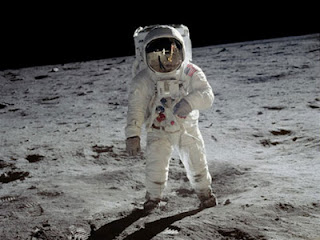

NASA doesn't charge us royalties on using these images. They are part of our culture, and belong to all of us. We are richer for having them. I don't know what dollar value to put on them, but it's got to be pretty large, especially if we listen to RIAA and the film industry.
So forget about all the fancy technology we enjoy as a result of the Moon landings. I think we may even have turned a profit just on the intellectual property assets alone.

This very famous image of Earth was taken by the astronauts of Apollo 17. It has been seen by pretty much everybody, and has been used so much as to have become a cliché. And yet, it's still an amazingly beautiful and inspiring shot.
But was it worth all the money spent to go to the Moon? There were many people at the time who thought it was a waste, and people today still make that argument. Advocates of space exploration point out that the technologies developed as part of the Apollo program played an invaluable role in advancing our standard of living here on Earth, and there's truth to that, certainly. We have a lot of neat gadgets that we probably never would have developed had it not been for Apollo.
But I want to talk about something else. Look at that image again, and think of how often you've seen it before. It's appeared in books and magazines, T-shirts and posters, advertising campaigns... you name it. It's such a compelling image, it's used everywhere.
Now, copyright and piracy are very much on people's minds these days, and the RIAA in particular is complaining about losing staggering amounts of money to unauthorized copying. Whether their claims are accurate or not, we can agree that images like this photo have commercial value. So I'd like you to consider for a moment just how rich you'd expect to be from royalty payments if you owned the copyright to that iconic photo of the Earth.
Of course, if NASA charged royalties for the use of that photo, it probably wouldn't have been used by nearly so many people, and they almost certainly would have had the same problem that RIAA complains of when it comes to collecting from everyone who uses it. But that isn't really the point. What I want to argue is that if you were to sit down and put a dollar value on the intellectual property of that one, single photograph, taking into account how many people have used it for how many different purposes, the amount of value generated would be staggering. Now, think about these images:

NASA doesn't charge us royalties on using these images. They are part of our culture, and belong to all of us. We are richer for having them. I don't know what dollar value to put on them, but it's got to be pretty large, especially if we listen to RIAA and the film industry.
So forget about all the fancy technology we enjoy as a result of the Moon landings. I think we may even have turned a profit just on the intellectual property assets alone.
Subscribe to:
Posts (Atom)